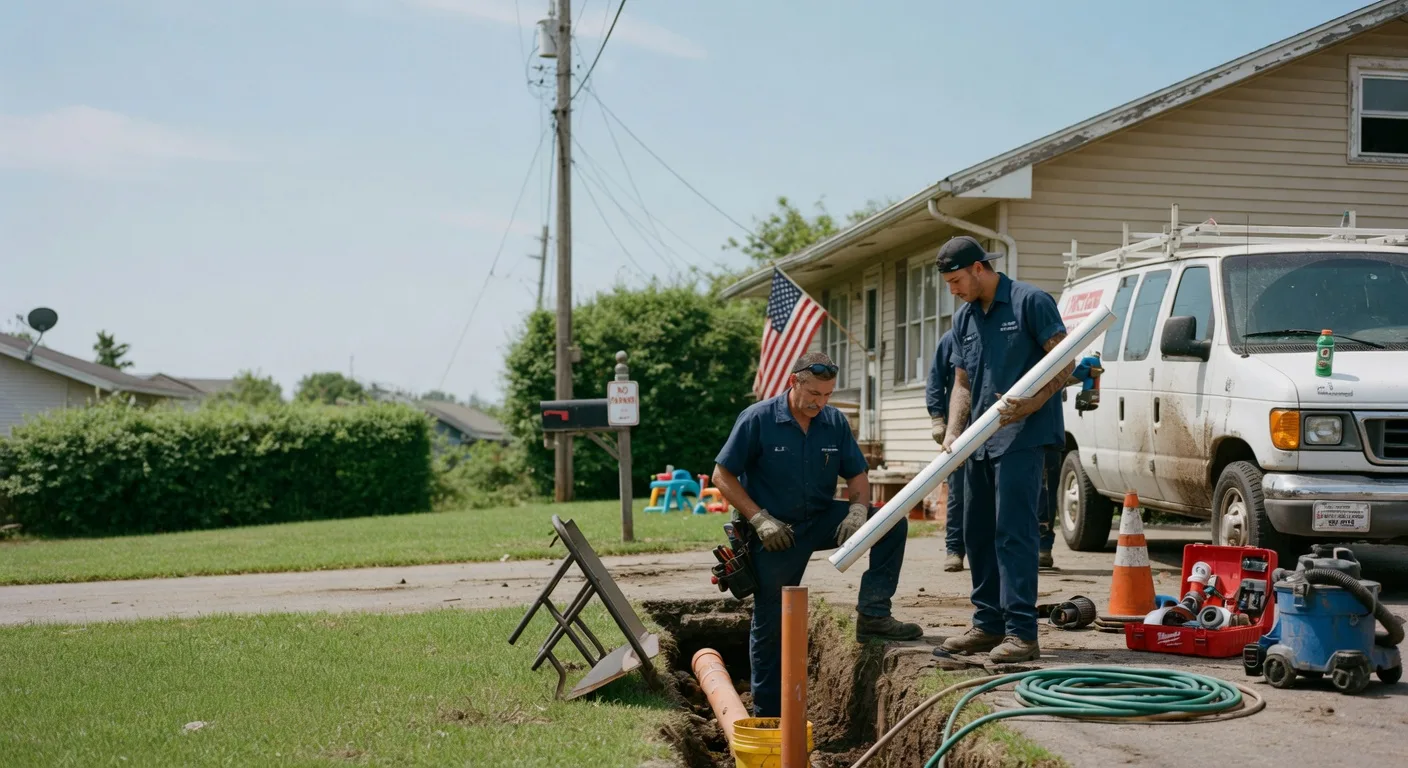
How often does a main sewer line actually need cleaning?
There is no set interval that fits every house. A main sewer line in good shape, with no symptoms, does not need cleaning on a calendar. A line with a known problem often does.
The usual reasons a main line needs repeat attention are root intrusion at a clay or loose joint, grease build-up on the pipe wall, or a bellied section that holds water and collects solids. Those problems do not go away after one cleaning. Roots regrow. A belly keeps holding water. A line like that may need cleaning on a schedule that suits what is found in it.
The way to set that schedule is a camera inspection. It shows the cause, the condition of the pipe and where the trouble sits, so the interval is based on what is in the line and not a guess.
Watch for the signs: slow drains in several fixtures, gurgling, a sewage smell, or the lowest drain in the house backing up. One slow sink is usually a branch line job. Several fixtures at once points to the main.
A cable machine is often enough for roots and soft blockage. Heavy grease or scale needs hydro jetting. A failed sewer lateral needs repair, not cleaning, and cost then depends on access, the materials, how much is opened up and any permit required. If sewage is backing up, stop running water and call. Expert Plumbers Co is a referral service. We refer you to a local plumber for Drain Cleaning or Emergency Drain Cleaning in Stockport, IA: (380) 262-9173.
What you notice between cleanings is more useful than the date on the calendar. Keep a simple note of when drains slow, when gurgling starts and how long each cleaning lasted. If the gap between problems keeps shrinking, the cause is getting worse and a camera inspection should come before the next cleaning. Older homes with clay or cast iron mains often show roots or scale returning within a year or two, while newer plastic mains usually stay clear much longer unless a joint has shifted or something was flushed that should not have been. A common mistake is paying for repeated cleanings without ever seeing the inside of the pipe. After a thorough cleaning and inspection, ask the plumber what the line looked like, how much was removed and when it makes sense to look again, so you leave with a plan.
My dishwasher leaves standing water at the bottom and the kitchen sink is slow too. Are they connected?
Yes, most of the time. The dishwasher drains into the same pipe as the kitchen sink, usually through the disposal or a connection on the tailpiece. If that shared pipe is partly blocked, both will slow down, and the dishwasher shows it first because it cannot push water out against the restriction.
Grease, food residue and soap film coat the inside of the kitchen drain and narrow it over time. A garbage disposal can pack ground food into that narrow spot. The result is water that sits in the bottom of the dishwasher after a cycle and a sink that empties slowly.
Safe checks you can do: look at the dishwasher filter at the bottom and clear any food. Check that the drain hose is not kinked behind the machine. If you have a disposal, make sure the knockout plug was removed when the dishwasher was installed. Run the disposal with cold water and see whether the sink drains better. Take off the trap under the sink with a bucket below, and clear what is in it. Skip chemical cleaners, which can damage the dishwasher hose and the disposal.
If the filter and trap are clean and both problems remain, the blockage is further down the kitchen line. A cable machine often clears a soft plug of grease and food. If it returns in a few weeks, grease on the pipe wall is the likely cause, and hydro jetting cleans the wall where a cable only cuts a hole through it. A camera inspection can show a sag, a damaged joint or roots further along.
Stop running the dishwasher and call if dirty water comes up in the sink during a cycle, if other drains in the house are also slow, or if you smell sewage.
If the sink drains fine once the dishwasher is off and the problem is only the machine, the cause may be in the appliance, such as the pump or drain hose, and that is a job for an appliance technician rather than a plumber.
Cost depends on access under the sink, how far the blockage sits, whether a cleanout is available, and how much has to be opened or replaced.
Expert Plumbers Co can connect you with an independent local plumber in Stockport, IA when you call (380) 262-9173.
My sink gurgles after it drains and someone mentioned an air admittance valve. What is that, and can it fail?
"My sink gurgles after it drains" is one of the most common things people notice before a drain problem gets worse. Every fixture needs a vent so water leaving the trap does not pull a vacuum. When air cannot get in, it gets dragged through the trap water instead, and that is the gurgle.
An air admittance valve, or AAV, is a small one-way valve fitted on a vent pipe, often under a sink or in an attic. It opens to let air in as water drains, then drops shut so sewer gas stays in the pipe. Many local codes allow them and some do not, so rules vary by area.
Yes, they can fail. The rubber seal wears, dust or debris stops the flap seating, or the valve sticks. A valve that will not open brings back the gurgling and slow draining. One that will not close lets a sewer smell into the cabinet or room.
A blocked vent stack on the roof, a partial clog in the drain, or a bellied line holding water can also cause gurgling. One gurgling fixture usually points to its own trap, branch line or vent. If the tub, toilet and floor drain all gurgle together, or the toilet bubbles when the washer empties, suspect the main line or the main vent.
Safe homeowner check: Run just the gurgling sink and listen, then run another fixture and see if it does the same. Do not pry at vent parts inside walls, and do not pour drain chemicals into a line that is already gurgling.
Stop running water and call now if sewage smell is strong, water comes up in a tub, shower or floor drain when you use another fixture, a toilet bubbles or rises, or any fixture stops draining.
A cable machine is usually enough for a clog in a single branch line, like the pipe behind one sink. If the gurgle returns, or several fixtures are affected, the plumber may want a camera inspection to look for root intrusion at a clay joint, a bellied line, or a failing section. A blocked roof vent is cleared from the roof, not with a drain cable.
Expert Plumbers Co is a referral service. We connect you with an independent local plumber in Stockport, IA. Call (380) 262-9173.
Ask the plumber whether an AAV is permitted where you live, or whether a conventional vent is needed instead. Cost depends on access to the pipe, the parts or materials needed, how much wall or ceiling has to be opened, and any permit or code requirement.
We live in a manufactured home. Why do the drains under the floor keep clogging?
You live in a manufactured home, and the drains keep clogging. A sink runs slow, the tub gurgles, or the toilet backs up every few months. The cause is usually under the floor, where you cannot see it.
Drain lines in a manufactured home run through the belly wrap, between the floor framing and the ground. The runs are long and shallow, with very little fall, so water and solids move slowly and grease, soap and paper settle. Over time the hangers that hold the pipe can fail and the line sags. A sagging section becomes a bellied line that holds water and collects debris. Lightweight plastic pipe can also crack or pull apart at joints when the ground shifts.
Cold weather adds a problem. Pipes under the floor can freeze, and a frozen drain looks like a clog until it thaws. Roots can also reach the outside section where the home ties into the sewer.
One slow fixture is usually a branch or trap problem near that fixture. If sinks, tub, toilet and washer all slow down together, or water comes up in the lowest fixture, the main run under the home or the sewer connection is the likely spot.
Safe homeowner check: Run each fixture one at a time and note which are slow. Look for a cleanout outside near the home and see whether it holds water, without opening it under pressure. Do not crawl under the home if it is wet or smells of sewage.
Stop running water and call now if sewage is coming up inside, if water drips from the belly wrap, if the floor feels soft, or if the smell of sewage is strong under or around the home.
A cable machine is often enough for a soft clog in one branch. Hydro jetting is the better tool for build-up on the wall of a long, shallow run. A camera inspection is the right step when clogs keep returning, because it can show a sag, a cracked joint or a separated pipe.
Expert Plumbers Co is a referral service. We connect you with an independent local plumber in Stockport, IA. Call (380) 262-9173.
Ask the plumber how they will reach the pipe and whether the belly wrap has to be opened and resealed. The scope depends on access under the home, how much belly board or insulation comes off, the pipe material, whether hangers need replacing to restore the slope, and any permit or code requirement.
The plumber wants to pull the toilet to reach the line. Why would they do that?
You called about a slow drain, and now the plumber says the toilet has to come off the floor. It is actually a common and sensible move, and it is often the cleanest way in.
A cable or jetting hose needs a way into the line. The best entry is a cleanout, a capped pipe fitting on the main drain. Many houses do not have one, or it is buried, painted over or blocked by a wall. Without a cleanout, the toilet is usually the best access point in the house. Pulling it exposes the closet flange and gives the plumber a short, straight shot into the closet bend and then into the main. Going in through a sink or tub means tight turns and a trap, and the tool may never reach the real problem.
It matters most when the blockage is past the branch lines. Roots at a clay joint, a belly holding water, or grease further down the main sit well beyond the bathroom. A straight path lets the cable or jet hose get there with enough control to clear it and, if a camera is used, to see what the pipe looks like.
Think about whether it is one fixture or the whole house. If only the bathroom sink is slow, the plumber should work at that sink. If the toilets gurgle, the tub backs up and a floor drain bubbles, the problem is in the main, and pulling the toilet is a reasonable way to reach it.
Safe homeowner check: look in the basement, crawl space or outside wall for a capped cleanout fitting on the main drain, and tell the plumber where it is. Do not pull the toilet yourself unless you are comfortable with it. The bolts can seize, and the bowl is heavy.
Stop running water and call now if sewage is coming up in a tub or floor drain, if the toilet is overflowing, or if you smell sewer gas.
A cable machine is enough for a simple clog near the closet bend. Roots, a belly or heavy build-up usually call for a camera inspection first, and hydro jetting to clean the pipe wall.
Expert Plumbers Co is a referral service. We connect you with an independent local plumber in Stockport, IA. Call (380) 262-9173.
Ask the plumber if a cleanout will be added so the next visit does not need the toilet pulled. Also ask about the new wax ring and any damaged bolts or flange, since the toilet must be reset and sealed afterward. Scope depends on access, parts, the condition of the floor around the flange, and any code requirement for adding a cleanout.